Top 50 FMCG Brands Offering Distributorship Opportunities in India
Top 50 FMCG Brands Offering Distributorship Opportunities in India (2026 Complete Guide)
Introduction
India's Fast-Moving Consumer Goods (FMCG) industry is one of the largest sectors in the country's economy. The market includes packaged foods, beverages, dairy products, personal care products, household goods, and health-focused consumer products.
As consumer demand continues to rise across urban and rural India, FMCG companies are aggressively expanding their distribution networks. This creates significant opportunities for distributors, dealers, wholesalers, super stockists, and channel partners.
A well-managed FMCG Distributorship offers recurring demand, fast inventory turnover, strong brand support, and long-term business growth potential.
The outlook for 2026 and beyond remains highly positive, making FMCG one of the most attractive sectors for entrepreneurs seeking a profitable FMCG Business Opportunity.
Benefits of FMCG Distributorship
- Recurring customer demand
- Fast inventory movement
- Established brand support
- Scalable business model
- Lower risk compared to manufacturing
- Long-term growth potential
- Wide range of product categories
- Repeat purchase behavior
FMCG Distribution Business Model
The FMCG supply chain generally follows this structure:
Manufacturer → Super Stockist → Distributor → Retailer → Customer
Manufacturers produce goods, super stockists maintain inventory, distributors supply retailers, and retailers sell directly to consumers.
A successful FMCG Distribution Business depends on:
- Inventory Management
- Retail Coverage
- Territory Expansion
- Logistics Efficiency
- Retailer Relationships
- Demand Forecasting
Top 50 FMCG Brands Offering Distributorship Opportunities in India
| Brand | Product Category | Investment Required | Estimated Margin | Market Presence |
|---|---|---|---|---|
| Parle | Food | ₹2-10 Lakh | 8-15% | Pan India |
| Haldiram's | Snacks | ₹5-15 Lakh | 8-18% | Pan India |
| Balaji Wafers | Snacks | ₹3-10 Lakh | 8-16% | National |
| Bikano | Food | ₹3-10 Lakh | 8-15% | National |
| Bisk Farm | Food | ₹2-8 Lakh | 7-15% | Regional/National |
| ITC Foods | Food | ₹5-20 Lakh | 6-14% | Pan India |
| Too Yumm | Snacks | ₹2-10 Lakh | 8-16% | National |
| Unibic | Food | ₹2-8 Lakh | 7-15% | National |
| Patanjali Foods | Food | ₹5-15 Lakh | 8-20% | Pan India |
| Organic India | Health | ₹3-10 Lakh | 10-20% | National |
| Bisleri | Beverages | ₹5-20 Lakh | 5-12% | Pan India |
| Coca-Cola | Beverages | ₹10-25 Lakh | 5-10% | Pan India |
| PepsiCo | Beverages | ₹10-25 Lakh | 5-10% | Pan India |
| Campa | Beverages | ₹3-15 Lakh | 5-12% | National |
| Paper Boat | Beverages | ₹3-10 Lakh | 6-15% | National |
| Dabur | Personal Care | ₹5-20 Lakh | 8-18% | Pan India |
| Himalaya | Personal Care | ₹3-15 Lakh | 8-20% | Pan India |
| Nivea | Personal Care | ₹5-15 Lakh | 8-18% | National |
| Mamaearth | Personal Care | ₹3-10 Lakh | 10-20% | National |
| WOW | Personal Care | ₹3-10 Lakh | 10-20% | National |
| HUL | Home Care | ₹10-25 Lakh | 6-15% | Pan India |
| P&G | Home Care | ₹10-25 Lakh | 6-15% | Pan India |
| Jyothy Labs | Home Care | ₹3-15 Lakh | 7-15% | National |
| Savlon | Health Care | ₹3-10 Lakh | 8-18% | National |
| Lizol | Home Care | ₹3-10 Lakh | 8-18% | National |
| Johnson & Johnson | Baby Care | ₹5-15 Lakh | 8-18% | Pan India |
| Nestlé | Food & Nutrition | ₹10-25 Lakh | 6-15% | Pan India |
| Mother Sparsh | Baby Care | ₹3-10 Lakh | 10-20% | National |
| Mee Mee | Baby Care | ₹2-8 Lakh | 10-20% | National |
| Pigeon | Baby Care | ₹2-8 Lakh | 10-20% | National |
| Amul | Dairy | ₹5-15 Lakh | 5-12% | Pan India |
| Mother Dairy | Dairy | ₹5-15 Lakh | 5-12% | North India |
| Britannia | Food | ₹5-15 Lakh | 6-15% | Pan India |
| Tata Consumer | Beverages | ₹5-15 Lakh | 6-15% | Pan India |
| Wagh Bakri | Beverages | ₹2-10 Lakh | 8-15% | National |
| Emami | Personal Care | ₹5-15 Lakh | 8-18% | Pan India |
| Godrej Consumer | Personal Care | ₹5-15 Lakh | 8-18% | Pan India |
| Reckitt | Health/Home Care | ₹5-20 Lakh | 8-18% | Pan India |
| Pidilite | Household | ₹5-20 Lakh | 8-18% | Pan India |
| Cavinkare | Personal Care | ₹3-10 Lakh | 8-18% | National |
| Storia | Beverages | ₹2-8 Lakh | 8-15% | Growing |
| Zed Black | Consumer Goods | ₹2-10 Lakh | 10-20% | National |
| KLF Nirmal | Food | ₹2-10 Lakh | 8-15% | Regional |
| Origami | Consumer Goods | ₹2-8 Lakh | 8-18% | National |
| Catch | Food | ₹3-10 Lakh | 8-15% | National |
| Rasna | Beverages | ₹2-8 Lakh | 8-15% | National |
| Frooti | Beverages | ₹5-15 Lakh | 5-12% | Pan India |
| Lotus Herbals | Personal Care | ₹3-10 Lakh | 10-20% | National |
| Henkel | Home Care | ₹5-15 Lakh | 8-15% | National |
| Wipro Consumer | Personal Care | ₹5-15 Lakh | 8-15% | National |
| Godrej Aer | Home Care | ₹3-10 Lakh | 8-15% | National |
| Clear Water | Beverages | ₹2-8 Lakh | 5-12% | Regional |
| Hector Beverages | Beverages | ₹3-10 Lakh | 6-15% | National |
| Organic Wellness | Health Products | ₹2-8 Lakh | 10-25% | Growing |
These FMCG Brands in India are attractive because they combine strong consumer demand, established market presence, proven distribution systems, and scalable growth opportunities for distributors.
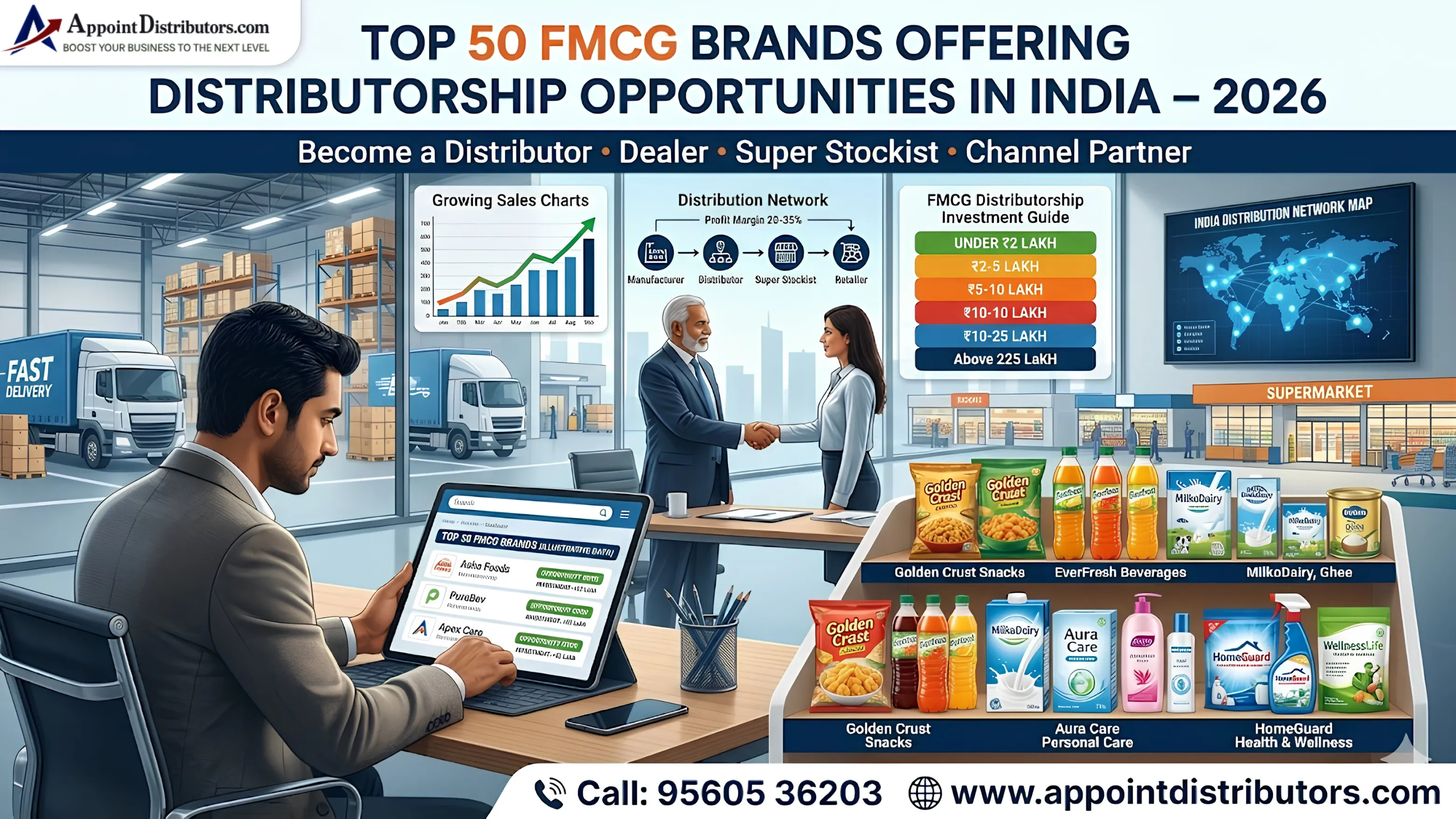
FMCG Distributorship Investment Guide
Under ₹2 Lakhs
Small regional brands, local FMCG products, and emerging consumer goods opportunities are available in this investment category.
₹2–5 Lakhs
This range provides access to regional food products, snacks, beverages, and personal care brands.
₹5–10 Lakhs
Many national FMCG brands offer distributor opportunities within this investment range.
₹10–25 Lakhs
Established national brands often require higher investment but provide larger territories and stronger support.
Above ₹25 Lakhs
This level generally supports super stockist and regional distribution operations.
Average Profit Margins in FMCG Distribution
Profit margins in the FMCG Distribution Business vary depending on the product category, brand strength, market demand, territory size, and sales volume. While some categories operate on lower margins but high volume, others offer premium margins due to specialized products and growing consumer demand.
| Category | Typical Margin Range | Demand Level | Growth Potential |
|---|---|---|---|
| Packaged Foods | 6% – 15% | Very High | High |
| Beverages | 5% – 12% | Very High | High |
| Dairy Products | 5% – 12% | Very High | Moderate |
| Personal Care | 8% – 20% | High | Very High |
| Home Care Products | 6% – 15% | High | High |
| Health Products | 10% – 25% | Growing | Very High |
| Organic Foods | 12% – 25% | Growing | Very High |
| Nutritional Supplements | 15% – 30% | Growing | Very High |
Successful distributors focus on a combination of high-volume products and high-margin products to maximize profitability and reduce business risk.
Explore FMCG Distribution Opportunities
The FMCG sector offers some of the most profitable distributorship opportunities in India for entrepreneurs, wholesalers, dealers, and channel partners. Businesses looking to expand can also explore super stockist opportunities and C&F agent opportunities across multiple FMCG categories.
Manufacturers actively seeking expansion often connect with verified FMCG distributors in India to improve market penetration and retail coverage. Companies can also use find distributors and find dealers solutions to grow their channel network.
Related FMCG Categories
The FMCG industry consists of multiple high-growth product categories that offer attractive opportunities for distributors and channel partners.
Food & Beverage
Food and beverage products are among the fastest-moving consumer goods in India. Daily consumption creates recurring demand and ensures steady inventory movement. Explore opportunities through Food & Beverage Distributors .
Packaged Foods
Packaged foods continue to grow due to convenience, urbanization, and changing lifestyles. Products include ready-to-eat meals, frozen foods, snacks, and instant foods.
Dairy Products
India remains one of the largest dairy-consuming countries in the world. Milk products, cheese, yogurt, butter, and ice cream continue to generate strong distributor demand.
Personal Care
Personal care products such as skincare, cosmetics, grooming products, and hygiene solutions offer excellent growth opportunities.
Home Care
Detergents, cleaners, dishwashing products, and air fresheners represent a stable FMCG distribution segment with repeat purchases.
Health & Wellness
Growing health awareness is driving demand for nutritional supplements, herbal products, immunity boosters, and wellness solutions.
Snacks & Confectionery
Snacks, chocolates, candies, and confectionery products remain among the highest-volume FMCG categories.
Beverages
Packaged water, soft drinks, juices, health drinks, and energy beverages continue to expand rapidly across urban and rural India.
Business Models in FMCG Distribution
Exclusive Distributor
An exclusive distributor receives territorial rights for a particular region.
Advantages:- Less competition
- Exclusive territory
- Better margins
- Higher targets
- Larger investment requirements
Super Stockist
Super stockists maintain large inventories and supply multiple distributors.
Advantages:- Large territory coverage
- Higher turnover potential
- Higher capital investment
- Warehouse requirements
Area Distributor
Area distributors focus on serving a city, district, or local territory.
Advantages:- Lower investment
- Manageable operations
- Limited geographical reach
Regional Distributor
Regional distributors manage multiple territories or states.
Advantages:- Higher revenue opportunities
- Broader market presence
- Complex logistics management
Wholesale Distributor
Wholesale distributors supply retailers and smaller distributors.
Advantages:- Large customer base
- Fast inventory movement
- Lower margins
Channel Partner
Channel partners support business expansion through retail and distribution networks.
Location-Based FMCG Distributorship Opportunities
Delhi
Delhi offers one of India's largest retail markets with strong demand for packaged foods, beverages, and personal care products.
Mumbai
Mumbai remains a premium FMCG market due to high purchasing power and dense population.
Bangalore
Bangalore creates opportunities for premium products, health foods, and wellness categories.
Hyderabad
Rapid urbanization and retail growth continue to drive FMCG expansion.
Chennai
Chennai provides opportunities across food products, beverages, and household goods.
Pune
A growing middle-class population supports FMCG consumption growth.
Kolkata
Kolkata remains an important market for packaged foods and daily essentials.
Ahmedabad
Ahmedabad continues attracting FMCG brands seeking distribution expansion.
Tier-2 Cities
Tier-2 cities are experiencing rapid growth in organized retail and consumer spending.
Rural India
Rural markets represent one of the biggest growth opportunities for FMCG distributors due to increasing income levels and better logistics infrastructure.
Factors to Consider Before Taking an FMCG Distributorship
Choosing the right FMCG Distributorship is critical for long-term business success. While many FMCG Distributor Opportunity options are available in the market, not every opportunity is suitable for every entrepreneur.
1. Investment Requirement
Different FMCG companies require different levels of investment. Some opportunities can be started with less than ₹2 lakh, while others may require ₹25 lakh or more.
2. Territory Exclusivity
Check whether the company provides exclusive distribution rights within your territory. Exclusive territories can help reduce competition and improve profitability.
3. Product Demand
Always evaluate consumer demand before selecting a product category. Daily-use products generally offer faster inventory turnover.
4. Competition
Analyze existing distributors and competing brands in your target market before investing.
5. Storage Requirements
Some products require specialized storage facilities, refrigeration, or larger warehouse space.
6. Logistics Capability
Efficient transportation and delivery systems play a crucial role in FMCG Products Distribution.
7. Brand Reputation
Established FMCG Brands in India generally provide better market acceptance and retailer support.
8. Margin Structure
Compare distributor margins, incentives, promotional schemes, and annual bonuses.
9. Working Capital
Adequate working capital is necessary to maintain inventory and provide retailer credit.
Fastest Growing FMCG Categories in India
Consumer behavior in India is changing rapidly. Health consciousness, premiumization, digital influence, and changing lifestyles are creating entirely new growth opportunities for distributors.
Organic Foods
Consumers increasingly prefer chemical-free and naturally sourced products. Organic food brands continue to expand distribution networks across India.
Health Drinks
Health drinks, protein beverages, energy drinks, and functional beverages are experiencing strong growth among young consumers and fitness enthusiasts.
Nutritional Supplements
The supplement market is growing because of rising awareness regarding fitness, immunity, and preventive healthcare.
Herbal Products
Ayurvedic and herbal products continue to gain popularity due to consumer trust in natural ingredients.
Premium Personal Care
Premium skincare, grooming products, and beauty products are attracting consumers willing to spend more on quality and innovation.
Eco-Friendly Products
Environmentally conscious consumers are creating demand for sustainable and eco-friendly household products.
Functional Foods
Foods designed to provide health benefits beyond basic nutrition continue to represent one of the most promising FMCG Business Opportunity segments.
Many distributors actively explore these opportunities through Food & Beverage Distributor Opportunities .
Requirements for Becoming an FMCG Distributor
Most FMCG companies evaluate distributors based on infrastructure, financial capability, territory coverage, and operational readiness.
GST Registration
GST registration is mandatory for most FMCG distribution businesses operating in India.
Trade License
A valid trade license may be required depending on local regulations and business structure.
Warehouse and Storage Facility
Warehouse space requirements vary according to product category and territory size.
Transportation Infrastructure
Distributors require delivery vehicles or logistics arrangements to ensure timely supply to retailers.
Working Capital
Adequate working capital is necessary to maintain inventory and provide retailer credit where required.
Sales Team
A trained sales team helps expand retailer coverage and improve product penetration.
Retail Network
Strong retailer relationships contribute significantly to distribution success.
Technology and Billing Systems
Modern distributors increasingly rely on inventory software, billing systems, CRM tools, and route management technology.
Common Mistakes New FMCG Distributors Make
Many distributors fail not because of poor opportunities but because of avoidable operational mistakes.
- Choosing the Wrong Territory
Solution: Conduct detailed market research before investing. - Underestimating Working Capital
Solution: Maintain sufficient liquidity for inventory and retailer credit. - Poor Inventory Planning
Solution: Use demand forecasting and inventory management tools. - Ignoring Retailer Relationships
Solution: Visit retailers regularly and provide excellent service. - Weak Sales Team Management
Solution: Invest in sales training and performance monitoring. - Ignoring Logistics Costs
Solution: Optimize delivery routes and transportation expenses. - Overexpansion Too Early
Solution: Build a strong foundation before expanding territories. - Selecting Low-Demand Products
Solution: Focus on products with proven local demand. - Ignoring Competitor Analysis
Solution: Monitor competing brands regularly. - Failure to Adopt Technology
Solution: Implement modern inventory and billing solutions.
How to Apply for FMCG Distributorship Opportunities
The application process for an FMCG Distributorship is relatively straightforward when approached systematically.
Step 1: Identify Suitable Categories
Choose categories that align with your investment capacity and local market demand.
Step 2: Research Available Opportunities
Explore verified FMCG Distributor Opportunity listings and evaluate brands carefully.
Visit: https://www.appointdistributors.com/
Step 3: Prepare Business Documents
- GST Registration
- PAN Card
- Business Registration
- Address Proof
- Warehouse Details
- Financial Documents
Step 4: Submit Application
Apply directly through the manufacturer or distribution platform.
Step 5: Complete Verification
Companies may evaluate your infrastructure, territory, and financial capability.
Step 6: Finalize Agreement
Review distributor agreements carefully before signing.
Step 7: Launch Operations
Build retailer relationships, maintain inventory, and focus on territory expansion.
Interested entrepreneurs can register directly at: https://www.appointdistributors.com/register
Frequently Asked Questions (FAQs)
1. How much investment is required for FMCG distributorship?
Investment typically ranges from ₹2 lakh to ₹25 lakh or more depending on the brand and territory.
2. Which FMCG company offers the best distributor margins?
Health products, supplements, personal care products, and specialty FMCG categories often provide higher margins.
3. Is FMCG distributorship profitable in India?
Yes. FMCG products enjoy recurring demand and fast inventory movement, making the sector highly attractive.
4. How do I find FMCG distributorship opportunities?
Explore opportunities through https://www.appointdistributors.com/.
5. What documents are required?
GST registration, PAN card, address proof, business registration, and warehouse details are commonly required.
6. Can I become a distributor without experience?
Yes, many companies accept first-time distributors with proper infrastructure and capital.
7. What warehouse size is required?
Requirements vary from 500 sq. ft. to several thousand square feet depending on product category.
8. Can I handle multiple FMCG brands?
Yes, many distributors manage multiple non-competing brands.
9. What is the difference between distributor and super stockist?
A super stockist supplies multiple distributors, while a distributor supplies retailers.
10. Which cities offer the best FMCG opportunities?
Delhi, Mumbai, Bangalore, Hyderabad, Chennai, Pune, Kolkata, and Ahmedabad remain strong markets.
11. Are rural markets profitable?
Yes. Rural India represents one of the fastest-growing FMCG markets.
12. How long does approval take?
Approval timelines vary by company and can range from a few days to several weeks.
Businesses looking to connect directly with manufacturers can explore opportunities at: AppointDistributors.com
Interested entrepreneurs can register and discover available FMCG Distributor Opportunities at: AppointDistributors
What's Your Reaction?