How to Create a Distribution Strategy for a New Product Launch
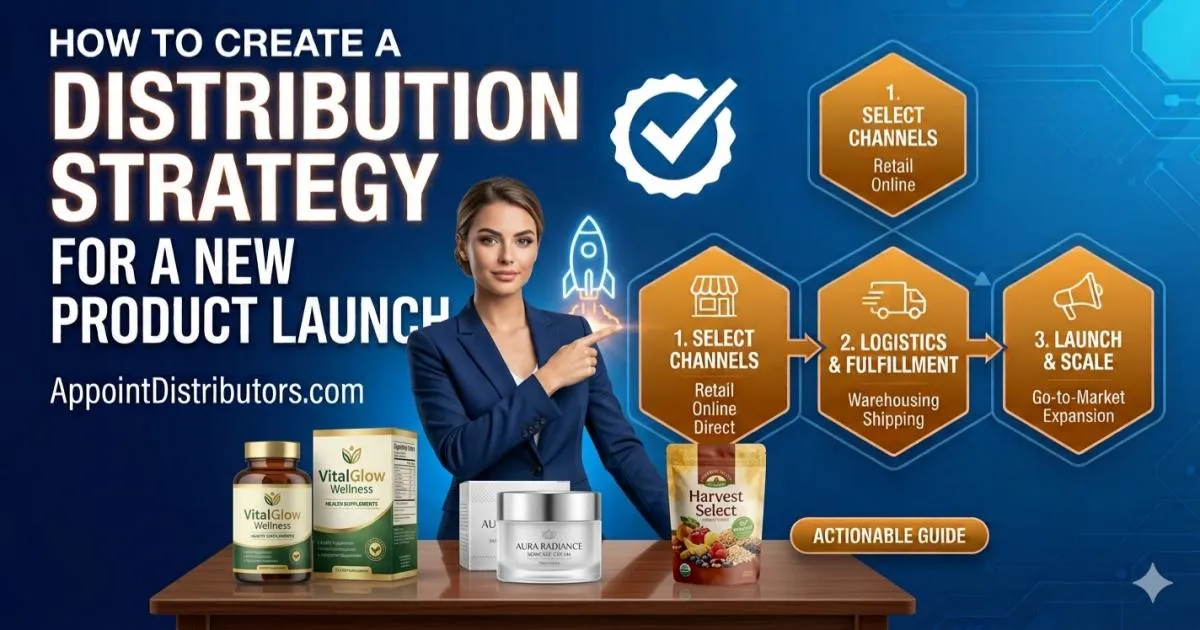
Launching a new product is not only about creating a great product and promoting it. A successful launch also depends on having the right distribution strategy in place.
Even when customers are interested in a product, limited availability can make it difficult for a brand to generate consistent sales. This is why companies need to decide in advance how their products will reach retailers, wholesalers, distributors and ultimately customers through Appoint Distributors.
A well-planned distribution strategy helps a business enter the right markets, con trol product availability, build a strong sales network and create opportunities for long-term growth.
If your product belongs to the food and beverage category, you can explore these Food & Beverage Distributors, verified through Appoint Distributors.
What Is a Distribution Strategy?
A distribution strategy is a planned approach that determines how a product will move from a company to the market and eventually reach customers.
Depending on the product and target market, a company may use distributors, wholesalers, retailers, online channels or a combination of different channels.
The right strategy depends on factors such as:
-
Product category
-
Target customers
-
Geographic market
-
Product price
-
Sales volume
-
Storage requirements
-
Competition
-
Available business partners
-
Expected market demand
Instead of trying to reach every market at once, businesses can create a structured distribution plan and expand gradually.
Why Is Distribution Planning Important for a New Product?
A new product has to overcome an important challenge: customers cannot purchase something that they cannot easily find.
A strong distribution plan can help a brand:
-
Improve product availability
-
Enter new markets systematically
-
Build relationships with local businesses
-
Reduce unnecessary distribution costs
-
Reach retailers more efficiently
-
Identify promising markets
-
Maintain better control over sales operations
-
Create a foundation for future expansion
Distribution should therefore be considered part of the product launch strategy rather than something that is handled after the product enters the market.
1. Define Your Target Market First
Before selecting distribution channels, identify exactly who is most likely to purchase your product.
Consider questions such as:
-
Who is the target customer?
-
Which cities or regions have potential demand?
-
Which type of retailers sell similar products?
-
What price range does the market accept?
-
How frequently will customers purchase the product?
-
Which competing products are already available?
For example, a product designed for local grocery stores may require a completely different distribution approach from a premium product sold through speciality stores.
Understanding the market first makes the rest of the distribution planning process much easier.
2. Decide Where You Want to Launch
A common mistake is trying to enter multiple cities or states immediately.
For a new product, a controlled market launch can provide useful information before a company invests heavily in expansion.
You can initially select markets based on:
-
Customer demand
-
Competition
-
Population
-
Existing retailer networks
-
Transportation costs
-
Product suitability
-
Availability of business partners
After evaluating performance in the initial markets, the company can expand into additional locations.
3. Choose the Right Distribution Channels
There is no single distribution channel that works for every product.
A company may consider:
Direct Distribution
The company sells directly to retailers or customers without depending heavily on intermediaries.
This can provide greater control over pricing, customer relationships and product presentation.
Distributor-Based Distribution
A distributor helps the company reach retailers and markets where establishing a direct sales network may be difficult.
This approach can be particularly useful when a brand wants to expand geographically without building its own sales infrastructure in every location.
Wholesale Distribution
Wholesalers can help move products in larger quantities and connect manufacturers with multiple retailers.
Online Distribution
Depending on the product, online marketplaces and an independent e-commerce website can also become part of the distribution mix.
Many businesses use a combination of these channels instead of relying on only one.
4. Decide How Much Market Coverage You Need
Not every product needs to be available everywhere.
Businesses should determine whether they want:
Wide market coverage:
The product is made available through a large number of outlets.
Focused market coverage:
The company concentrates on selected retailers, locations or customer segments.
Limited or selective coverage:
The company works with carefully selected outlets where the product is positioned according to its target market.
The appropriate approach depends on the product category, customer expectations and business objectives.
5. Set Clear Commercial Terms
Before expanding the distribution network, companies should establish clear commercial terms.
These may include:
-
Product price
-
Distributor margin
-
Retailer margin
-
Minimum order quantity
-
Payment terms
-
Credit period
-
Delivery responsibilities
-
Return and replacement policy
-
Promotional support
-
Territory-related conditions
Clear terms reduce confusion and help create better long-term business relationships.
If your new product falls under the health or personal care category, you can explore these verified Health & Personal Care Distributors through Appoint Distributors.
6. Select Distribution Partners Carefully
Finding a business partner is only one part of the process. The more important question is whether that partner is suitable for your product and target market.
Consider factors such as:
-
Existing market coverage
-
Retailer relationships
-
Product category experience
-
Sales team
-
Storage facilities
-
Financial capacity
-
Delivery capabilities
-
Knowledge of the local market
-
Existing product portfolio
A partner with strong local market knowledge may provide valuable support when a brand enters an unfamiliar region.
7. Plan Inventory and Logistics
A distribution strategy can fail even when demand exists if products are not available at the right time.
Before launching, determine:
-
Where inventory will be stored
-
How products will be transported
-
Expected delivery timelines
-
Reorder levels
-
Stock requirements
-
Packaging requirements
-
Handling requirements
-
How damaged or returned products will be managed
For products with short shelf lives or special storage requirements, logistics planning becomes even more important.
8. Create a Retailer Expansion Plan
Distributors alone do not guarantee market penetration.
A company should also understand how its product will reach retailers.
For example, the expansion process may look like:
Company → Distributor → Retailer → Customer
The company can work with its distribution partners to identify suitable retail outlets and gradually increase product availability.
Tracking the number of active retailers, repeat orders and sales per location can help identify which markets are performing well.
9. Support the Product After Launch
Distribution does not end when the first shipment reaches the market.
A new product may require continued support through:
-
Product information
-
Promotional material
-
Retailer communication
-
Sales training
-
Market feedback
-
Customer feedback
-
Promotional campaigns
-
Regular stock monitoring
This support can help businesses identify problems early and improve their market strategy.
10. Measure Distribution Performance
Once the product is launched, measure the results instead of relying only on total sales.
Useful metrics may include:
Market Coverage
How many target locations or retailers currently have the product?
Order Frequency
How frequently are distributors and retailers reordering?
Product Availability
How often is the product unavailable when customers want it?
Sales by Region
Which cities or territories are generating stronger demand?
Retailer Activation
How many retailers are actively selling the product rather than simply stocking it once?
Inventory Movement
How quickly is the available inventory being sold?
These metrics can help a company decide where to increase investment and where the distribution model needs improvement.
Common Distribution Mistakes New Brands Should Avoid
Several mistakes can make product expansion more difficult.
Entering Too Many Markets at Once
Rapid expansion can increase logistics costs and make it difficult to monitor performance.
Choosing Partners Only on the Basis of Size
A large business partner is not automatically the right fit for every product.
Ignoring Retailer Feedback
Retailers interact directly with customers and can provide valuable information about demand, pricing and competition.
Poor Inventory Planning
Stock shortages can result in lost sales, while excessive inventory can increase storage and working-capital pressure.
Not Defining Responsibilities
Companies and their distribution partners should clearly understand who is responsible for sales, delivery, promotion, inventory and customer support.
Failing to Review Performance
A distribution strategy should evolve as the company learns more about its market.
If your new product falls under the home cleaning category, you can explore these verified Home Cleaning Distributors through Appoint Distributors.
How to Build a Distribution Strategy Step by Step
A simple framework for a new product launch can be:
Step 1: Identify the target customer.
Step 2: Research potential markets.
Step 3: Select the initial cities or territories.
Step 4: Decide which distribution channels are appropriate.
Step 5: Define pricing and commercial terms.
Step 6: Identify suitable business partners.
Step 7: Prepare inventory and logistics.
Step 8: Launch the product in selected markets.
Step 9: Monitor sales, availability and retailer activity.
Step 10: Improve the strategy and expand into additional markets.
This approach allows a company to learn from its initial launch instead of making large expansion decisions without sufficient market information.
Frequently Asked Questions
What is a distribution strategy for a new product?
A distribution strategy is a plan that defines how a new product will move from the company to distributors, wholesalers, retailers or customers and which markets the business will target.
How should a new brand choose its first market?
A new brand can evaluate potential markets based on customer demand, competition, retailer availability, logistics costs, product suitability and existing business relationships.
Should a new product launch in multiple cities at once?
Not necessarily. Some businesses begin with selected markets, evaluate performance and then expand gradually. The appropriate approach depends on the product, available resources and business objectives.
What should a company consider when selecting a distributor?
Important considerations can include market coverage, relevant product experience, retailer relationships, sales capabilities, storage facilities, logistics and financial capacity.
How can a company measure distribution performance?
Businesses can monitor metrics such as market coverage, product availability, reorder frequency, sales by region, active retailers and inventory movement.
Can a company use multiple distribution channels?
Yes. Depending on the product and target market, a company may combine distributors, wholesalers, direct sales, retailers and online channels.
Why is retailer feedback important?
Retailers can provide information about customer demand, product movement, pricing, competition and common customer questions. This information can help a company refine its distribution strategy.
When should a distribution strategy be changed?
A company may review its strategy when sales performance, customer demand, inventory movement, logistics costs or market conditions change significantly.
If you are looking for ideas to start or expand your business during the festive season, explore these Diwali Business Opportunities for practical ideas and potential opportunities.
Final Thoughts
A successful product launch requires more than creating demand. The product also needs to be available in the places where potential customers are looking for it.
A clear distribution strategy helps businesses plan their markets, choose suitable channels, work with the right partners and monitor performance after launch.
For a new brand, starting with carefully selected markets and gradually expanding based on real performance can make distribution planning more structured and measurable.
The key is to treat distribution as an ongoing business strategy rather than a one-time activity. As customer demand, market conditions and sales performance change, the distribution plan should also evolve.
What's Your Reaction?